
Manual vs Automated Calibration in Metrology Labs
The comparison of manual vs automated calibration has become increasingly relevant for modern metrology laboratories operating in competitive and highly regulated environments. These laboratories are responsible for maintaining measurement accuracy, traceability, and regulatory compliance across industries such as aerospace, electronics, manufacturing, pharmaceuticals, and energy. As customer expectations rise and instrument volumes continue to grow, laboratories must adopt calibration strategies that balance efficiency, consistency, and quality.
Traditional calibration workflows were originally developed for lower throughput environments with limited instrument inventories. Today’s laboratories, however, face higher workloads, tighter tolerances, shorter turnaround expectations, and more frequent audits. This operational shift has forced many organizations to reassess existing processes and determine whether legacy approaches can still support long-term business objectives.
What Is Manual Calibration?
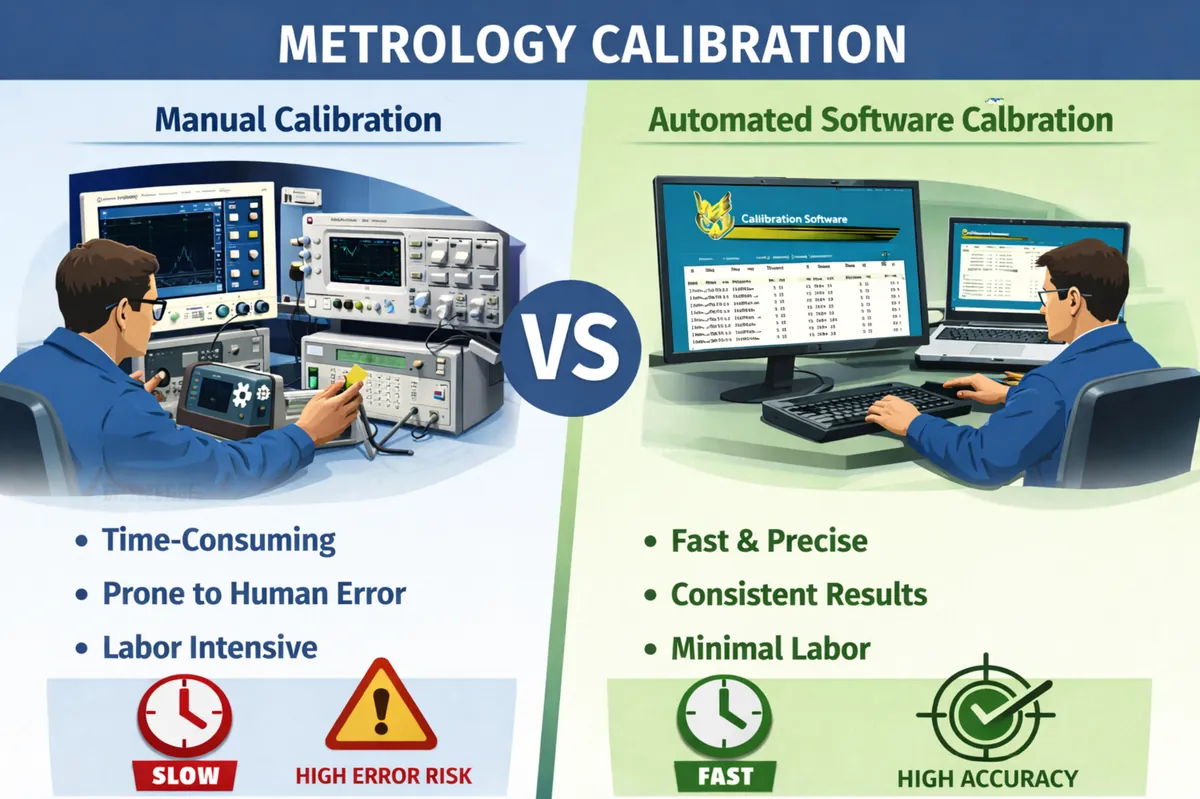
Manual calibration relies on technicians performing measurement steps by hand while following documented and approved procedures. In discussions involving manual vs automated calibration, manual methods are often associated with a higher dependence on individual skill, experience, and interpretation. Measurement results are typically recorded manually or entered into spreadsheets, increasing administrative effort and the potential for inconsistency.
While manual calibration can be effective in low-volume, research-focused, or highly specialized environments, maintaining consistent execution becomes more challenging as laboratories scale. Differences in technique, judgment, and documentation practices between technicians or shifts can introduce variability that impacts repeatability and overall confidence in results.
Operational Challenges with Manual Calibration
International standards such as ISO/IEC 17025 define strict requirements for calibration traceability, documentation, and measurement uncertainty in accredited laboratories.
As workloads increase, laboratories relying primarily on manual calibration workflows often encounter several operational limitations:
- Inconsistent results between technicians or work shifts
- Higher likelihood of transcription and calculation errors
- Longer calibration cycle times and reduced throughput
- Difficulty scaling operations efficiently
- Strong reliance on individual expertise
- Greater effort required during ISO/IEC 17025 audits
These challenges can create bottlenecks, reduce productivity, and increase audit risk, particularly for laboratories handling large instrument volumes or operating across multiple locations.
What Is Automated Calibration?
Automated calibration uses software-controlled workflows to execute predefined measurement procedures in a consistent and repeatable manner. When comparing manual vs automated calibration, automation significantly reduces variability by enforcing validated sequences and minimizing human intervention during execution.
Calibration instruments communicate directly with software systems, allowing measurement data to be captured digitally and reports to be generated automatically. This structured approach ensures procedures are executed the same way every time, regardless of operator, shift, or location.
In many laboratories, automated calibration is managed through calibration management software , which provides centralized scheduling, instrument tracking, controlled procedures, and audit-ready documentation. This integration ensures that automated calibration execution remains traceable, consistent, and compliant with ISO/IEC 17025 requirements across all laboratory operations.
Automated approaches are commonly implemented through calibration automation software , which enables metrology laboratories to standardize calibration workflows, establish reliable instrument communication, and generate consistent, audit-ready reports. By reducing manual intervention and enforcing validated procedures, calibration automation software helps laboratories improve repeatability, maintain traceability, and scale operations while meeting ISO/IEC 17025 compliance requirements.
Key Benefits for Modern Metrology Labs
Laboratories that adopt automated calibration systems typically experience measurable improvements across performance, efficiency, and compliance:
- Standardized execution of calibration procedures
- Improved repeatability and confidence in measurement results
- Reduced technician-to-technician variability
- Faster turnaround times and higher throughput
- Digitally traceable and audit-ready documentation
- Scalable operations without proportional staffing increases
These advantages allow laboratory teams to focus more on quality assurance, method improvement, and customer service rather than repetitive manual tasks.
Manual vs Automated Calibration Comparison
Manual Calibration
Manual workflows are typically more time-consuming and harder to scale. In a manual vs automated calibration evaluation, manual processes often require greater oversight, more documentation effort, and increased dependence on technician expertise as volume grows.
Automated Calibration
Automated calibration provides consistent execution, improved traceability, and long-term scalability, making it well suited for laboratories managing high instrument volumes and strict compliance requirements.
Choosing the Right Approach for Modern Laboratories
While manual calibration may remain appropriate for certain low-volume or research-based applications, broader industry analysis shows that automation offers clear advantages for laboratories focused on efficiency, consistency, and regulatory confidence. The long-term evaluation of manual vs automated calibration increasingly favors standardized, software-driven solutions.
As competition within the calibration industry intensifies, laboratories that invest in automation are better positioned to meet future demand while maintaining accuracy, repeatability, and compliance with international standards.
Many laboratories transition to automation by adopting automated calibration software that integrates execution, data capture, and compliance into a single controlled environment.
Frequently Asked Questions
Is automated calibration more accurate than manual calibration?
Automated calibration improves consistency and repeatability when compared in a manual vs automated calibration workflow by executing predefined measurement sequences, reducing technician-to-technician variability.
Can manual calibration still be used in metrology laboratories?
Yes. Manual calibration remains suitable for low-volume or highly specialized applications, but in a manual vs automated calibration comparison, automation is better suited for scalable, high-throughput metrology environments.
Does automated calibration support ISO/IEC 17025 compliance?
Yes. Automated calibration supports ISO/IEC 17025 by providing standardized execution, traceable measurement data, and audit-ready documentation.